
You have the ambition. You have the grades. Now you need the destination that gives you the most value for your investment.
For students from Pakistan, India, Bangladesh, Nigeria, and the Middle East, Germany has quietly become one of the smartest choices in the world. Not because of flashy marketing campaigns, but because of hard numbers: tuition-free public universities, a thriving economy hungry for skilled workers, and a clear 18-month pathway to a professional career after graduation.
This is not a destination for everyone. It demands preparation, language skills, and careful planning. But for those who put in the work, Germany offers something rare—a world-class education that does not leave you or your family in debt.
At AAA Educator, we have guided countless students through the German application maze. Here is what you need to know for the 2026 intake.
Why Germany in 2026? The Case for Studying Here
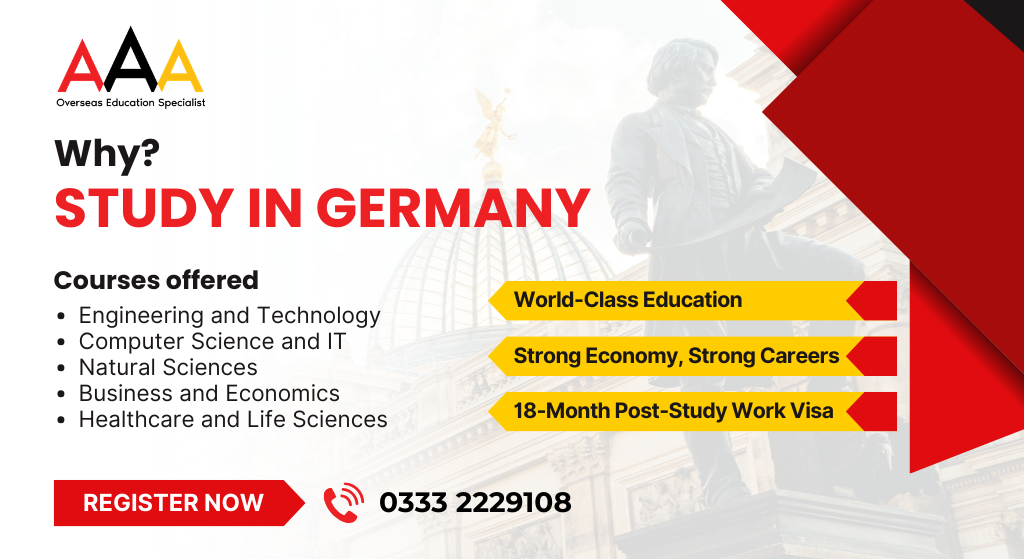
World-Class Education
German universities are renowned for excellence in engineering, computer science, business, and research. The country invests heavily in higher education, and the quality shows.
Strong Economy, Strong Careers
Germany is Europe’s largest economy. Companies like BMW, Siemens, Volkswagen, SAP, and Bosch actively recruit international graduates. Your degree here comes with built-in industry connections.
18-Month Post-Study Work Visa
After graduation, you can stay for 18 months to find a job related to your degree. During this time, you can work any job to support yourself while searching for your professional role.
Pathway to Permanent Residency
Once you secure qualified employment for two years and meet basic requirements, you can apply for a settlement permit—permanent residency in Germany.
Central Location in Europe
Germany’s heart-of-Europe location means weekends in Paris, Amsterdam, Prague, or Zurich are not just possible—they are easy.
What You Need to Study in Germany (2026)
Here are the practical requirements every student must meet.
Academic Requirements
For undergraduate studies, you need a school leaving certificate that is recognised as equivalent to the German Abitur. For most Pakistani students, this means completing one year of university in Pakistan before applying, or completing a foundation course (Studienkolleg) in Germany.
For Master’s programs, you need a recognised bachelor’s degree in a related field. Your grades matter—German universities are competitive.
Language Requirements
This is where most students underestimate the challenge.
- German-taught programs: You need proof of proficiency, typically TestDaF or Goethe-Zertifikat C1 or C2. This takes time and serious effort.
- English-taught programs: You need IELTS or TOEFL. Many Master’s programs, especially in STEM fields, are taught in English.
- The reality: Even if your program is in English, learning German to at least B1 level is essential for daily life and job hunting.
Financial Requirements
You must prove you have enough money to cover your living costs for one year. For 2026, this means showing approximately €11,200 in a blocked account. This is non-negotiable for your visa application.
Visa Requirements
- Valid passport
- University admission letter
- Proof of financial resources (blocked account)
- Health insurance
- Language proficiency certificates
- APS certificate (for students from Pakistan, India, China, and certain other countries)
Can You Work While Studying?
Yes, and this is one of Germany’s biggest advantages for international students.
The Rules:
- Non-EU students can work 120 full days or 240 half days per year.
- This works out to approximately 20 hours per week during term time.
- You can work full-time during semester breaks.
- Student assistantships (HiWi jobs) at universities are ideal—they pay well and build your CV.
What You Can Earn:
- Minimum wage jobs: €12–€15 per hour
- Student assistant roles: €12–€18 per hour
- Internships: Often paid, sometimes generously
With 20 hours per week at €13 per hour, you can earn over €1,000 per month—enough to cover most of your living costs.
Popular Fields of Study for International Students
German universities excel in specific areas. Here is what international students most often pursue.
Engineering and Technology
- Mechanical Engineering
- Electrical Engineering
- Automotive Engineering
- Civil Engineering
- Renewable Energy
Computer Science and IT
- Data Science
- Artificial Intelligence
- Cybersecurity
- Software Development
- Business Information Systems
Natural Sciences
- Physics
- Chemistry
- Biology
- Mathematics
Business and Economics
- International Business
- Economics
- Finance
- Management
Healthcare and Life Sciences
- Medicine (highly competitive)
- Pharmacy
- Biotechnology
- Public Health
Why AAA Educator Should Be Your Partner for Germany
Navigating the German application process is not simple. Between APS certificates, blocked accounts, language requirements, and university applications, there are dozens of places where things can go wrong.
At AAA Educator, we have helped hundreds of students from Pakistan and the Middle East successfully reach Germany.
What We Offer:
- Honest assessment of your chances
- Guidance on which programs fit your profile
- Help with APS documentation
- Support for blocked account setup
- Application assistance for uni-assist and direct applications
- Visa guidance and interview preparation
- Pre-departure briefings so you know what to expect
We do not just send applications. We walk with you until you land safely in Germany.
Your Next Steps
Germany offers something no other major study destination can match: tuition-free education, strong career prospects, and a genuine pathway to permanent residency.
But it requires preparation. Language learning takes time. APS certificates take months. Applications have deadlines that do not wait.
Start now.
The 2026 intake is approaching. The students who succeed are the ones who begin early.
Ready to explore your German options? For expert guidance on studying in Germany, call or WhatsApp AAA Educator at 03332229108 today.