
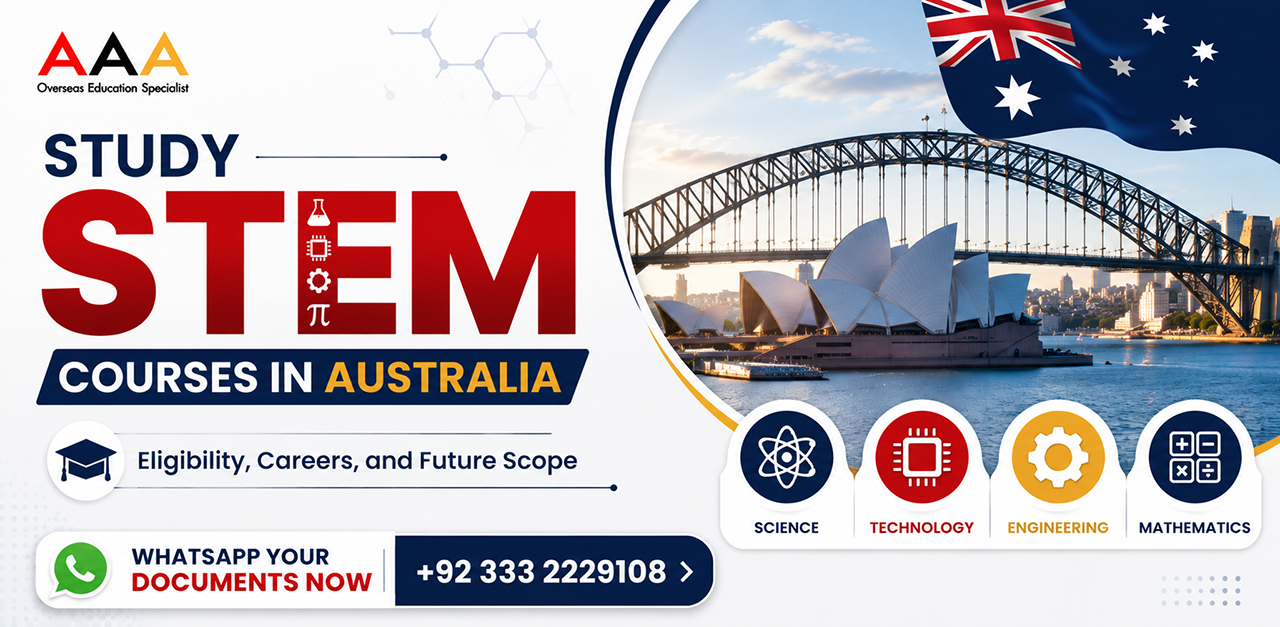
Australia offers international students a powerful combination of high-quality education, globally ranked universities, cultural diversity, stunning natural surroundings, and a welcoming community. For students interested in Science, Technology, Engineering, and Mathematics (STEM), Australia is an especially strong choice. The country provides a wide range of internationally recognised STEM programs designed to equip you with the skills and knowledge needed to succeed in a fast-moving, technology-driven world.
When you study STEM in Australia, you learn from highly qualified educators, access advanced research facilities, and connect with industry professionals. These experiences help you build practical skills, valuable networks, and insights that can accelerate your career.
Whether your interest lies in engineering, computer science, mathematics, or any other STEM-related field, studying in Australia opens up strong career possibilities and helps you achieve your academic and professional goals.
What STEM Stands For and What Careers It Offers
STEM stands for Science, Technology, Engineering, and Mathematics. This broad and growing field offers a wide range of career options for people with a strong interest in technical innovation, analytical thinking, and the connection between science and technology. A STEM degree can lead to many different career paths depending on your specific interests.
What You Can Do With a STEM Degree
STEM degrees open doors to diverse careers across multiple industries. If your interests lie in medicine, psychology, engineering, IT, animal health, agriculture, or food production, a STEM qualification can lead you there. Here is a breakdown of what you can pursue after studying STEM courses.
Agriculture and Food Production
These are essential fields of study. Learning how living systems interact with their environment and how to improve current systems is critical for better crop management and adapting to climate change.
Animal Health and Veterinary Sciences
This field plays an important role in improving animal welfare, optimising farming practices, and supporting conservation efforts for endangered species. It has a direct impact on environmental sustainability.
Engineering and IT
Engineering and IT are among the most in-demand skills globally. Professionals in these areas develop innovative solutions that create positive change, whether through advanced AI and computer science technologies or practical engineering projects.
Mathematics and Statistics
Mathematics and statistics are fundamental to every part of our world, including business, science, commerce, technology, and understanding human behaviour. These skills are applied across virtually all industries.
Medicine
The medical field covers a wide spectrum, from emergency response and patient care to research and development of cures and preventative treatments. Each area of study is essential to improving health outcomes.
Science
Science covers every aspect of life, from biology and geosciences to psychology and entomology. It offers many career opportunities that allow individuals to make a difference on both small and large scales.
Technology
Technology affects every part of our lives. The tools and systems we develop will increasingly shape the future, making this a field of constant growth and change.
STEM Education Options in Australia
Australia offers many excellent options for studying STEM. Four Australian universities rank in the global top 50 for civil and structural engineering, five for computer science and information systems, four for chemical engineering, four for mechanical, aeronautical, and manufacturing engineering, and four for electrical and electronic engineering.
Students typically begin with a broad undergraduate degree, such as a Bachelor of Science, and then specialise further at the postgraduate level.
The University of Sydney offers a wide range of courses in science, engineering, mathematics, medicine, agriculture, and IT at both Bachelor and postgraduate levels, including Masters and PhD programs. Their approach focuses on hands-on learning through purpose-built labs and learning hubs, with a global perspective that supports further study and international work opportunities.
The University of Melbourne provides programs ranging from molecular biology to artificial intelligence, designed to challenge curious minds and encourage exploration. The university also actively works to create a diverse graduate community and address gender and racial imbalances in STEM fields.
The Australian National University (ANU) aims to make STEM accessible to anyone with a genuine interest in the field. They offer a variety of science-related degrees and modern STEM applications, emphasising that STEM is not limited to lab coats and mathematics unless that is what you choose.
Employment Prospects for STEM Careers
STEM careers, especially in science, are in high demand and offer fast growth opportunities. However, the outlook varies depending on your area of interest. Generally, higher levels of education lead to stronger employment outcomes. The STEM fields in Australia with the best results in terms of employment, permanent residency pathways, and income include petroleum engineering, agricultural science, and ICT security architecture.
Australia’s STEM workforce is expected to grow at an annual rate of 2.5%, exceeding 1.9 million employees. The largest areas of STEM employment include the application of mathematics in business and the use of science in healthcare professions.
Information and Communication Technology (ICT) professionals are predicted to form Australia’s largest group of STEM workers. By 2024, employment in this field is expected to reach 376,000, accounting for 19.4% of all STEM jobs, up from 313,000 in 2019.
Business professionals make up approximately 20% of STEM workers, with this share expected to settle at around 19.5%. Health professionals form the third largest STEM occupational group, projected to account for 17.1% of jobs. Engineering ranks as the fourth largest category, with professional engineers expected to maintain approximately 9.1% of the STEM workforce.
A unique sixth category sits at the intersection of technology and creative arts. This group includes web designers, graphic artists, architects, urban and regional planners, surveyors, and spatial scientists, accounting for just over 7% of STEM jobs.
Why Pursue STEM in Australia
STEM in Australia offers a wide range of career paths, each with distinct opportunities and challenges. With the continued growth of technology and innovation, STEM qualifications remain in high demand. These courses focus on building skills that are essential to the country’s economy and long-term prosperity.
Choosing a career in STEM can be a rewarding decision for individuals who want to make a meaningful contribution to society while advancing their own professional and personal growth.
If you are interested in enrolling in STEM courses in Australia, you can seek guidance from our international education experts at IDP. They can assist you with course and university selection and support you through the entire admission process.
Start your comeback with a free consultation today. Let’s work together to get you back on track and closer to your goals.
Reach out to us on WhatsApp: 92 3332229108
AAA Educators